Ferdinand
Wann wird es endlich wieder so, wie es nie warFerdinand is the narrator’s childhood friend, whose recognition of him after a year’s absence turns a reunion into a small resurrection. Having mistaken the narrator for his dead brother, Ferdinand must see and hear him alive before he can accept that the person before him is not the one who died. Years later, Ferdinand reappears in the narrator’s family home, where he explains that an apparent symptom is also a deliberate strategy for remaining at the psychiatric institution.
Identity and Introduction
The narrator encounters Ferdinand on the grounds of the psychiatric institution after returning from a year away. Ferdinand is sitting on a bench near House L with a red cushion beneath him because he likes to sit softly. The narrator recognizes his old friend and calls out to him; Ferdinand, now an older and handsome young man in a shirt and pullover, appears stricken by the sight. His look, compared by the narrator to that of a pupil at an English boarding school, contrasts with the shock registering on his face.
The two have known each other since childhood: during a later visit, the narrator recalls the familiar smell of Ferdinand from years earlier, when they played together in the cellar. Their history gives the reunion its intimacy, but Ferdinand’s response shows that the year away has also become a period of uncertainty and loss.
The Mistaken Identity and Reunion
At first Ferdinand cannot speak. His mouth opens, his tongue moves without sound, and he makes repeated attempts to form words. When speech finally comes, he asks whether the narrator is alive. The question grows clearer through repetition, until Ferdinand can say plainly that the narrator is alive; the narrator answers that he is standing there in front of him and reminds him that he, too, is alive.
Ferdinand then embraces the narrator, circles around him, and repeatedly celebrates his return. He insists that the narrator is not his brother. Only then does the narrator understand: Ferdinand had confused him with the brother who died, because both brothers had been away. In the narrator’s account, Ferdinand makes him rise from the dead that day. The reunion is therefore not simply a recognition between old friends; it reveals how the brother’s death has unsettled the identities of those left behind, and how the narrator can be mistaken for the person he has lost.
Ferdinand at the Family Home
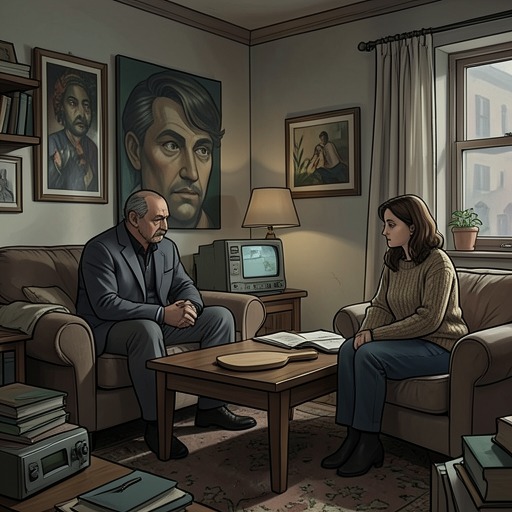
Ferdinand later opens the door during one of the narrator’s visits to his father. He says that he is keeping the father company. As they talk, Ferdinand echoes each of the narrator’s sentences, including the narrator’s questions and pleasantries, before supplying his own response. When asked why he is repeating everything, he explains that he has acquired the habit because the staff wanted to send him home. He calls it echolalia, but says that in this instance he is doing it deliberately as a disguise so that he can stay at the institution.
This exchange complicates the appearance of the behavior: what first seems like involuntary repetition is, by Ferdinand’s account, also a purposeful means of resisting discharge. The narrator’s visit also reconnects Ferdinand with the family’s private life. He remains with the ailing father as a companion, and the narrator finds him present again on a subsequent visit. The evidence presents this practical role without explaining how long Ferdinand stays or what becomes of him afterward.
Narrative Role and Agency
Ferdinand’s mistaken recognition makes the narrator’s return legible through the brother’s absence. His repeated insistence that the narrator is alive gives the scene its emotional force, while the misunderstanding exposes a grief that the narrator has not yet fully articulated. Ferdinand is not merely a witness to the narrator’s return: his recognition, even when initially mistaken, is what allows the narrator to experience it as a return among the living.
The later disclosure about echolalia adds a different kind of agency. Ferdinand describes himself as using an expected sign of illness to counter the institution’s attempt to send him away. The account does not establish his diagnosis or the broader circumstances of his treatment, but it does show him making a deliberate choice within the limits placed on him. Across both scenes, Ferdinand’s words change what others understand: first, he names the narrator’s survival; later, he explains the purpose behind his own repeated speech.